 CN 235 MPA TNI AU produksi PT DI [Iben Saputra] ☆
Pesawat produksi PT Dirgantara Indonesia (PTDI) memiliki teknologi yang mendukung kegiatan logistik nasional, baik orang, jasa dan barang hingga di pulau-pulau terpencil serta perkampungan yang terisolasi lembah dan pegunungan yang curam.
"Pesawat PTDI memiliki keunggulan yang mendukung kegiatan penerbangan di daerah terpencil dimana infrastruktur masih terbatas," kata Direktur Utama PTDI, Budi Santoso dalam wawancara khusus dengan Antara di Bandung, Selasa.
Menurut dia, karakter geografi wilayah Indonesia dengan perairan lebih luas daripada daratan serta belasan ribu pulau yang terpencar membutuhkan kekuatan transportasi udara yang kuat, terutama dalam hal kemampuan pesawat udara.
Selain itu, kata Budi, infrastruktur penerbangan di wilayah pedalaman dan terpencil yang masih terbatas menuntut kemampuan pesawat terbang untuk dapat beroperasi dalam kondisi khusus.
 "Landasan pacu di daerah terpencil pendek dan permukaannya kasar atau berumput," katanya.
Dia menambahkan bahwa salah satu pesawat terbang PTDI, CN235 memiliki teknologi STOL (Short Take-Off and Landing) atau mampu tinggal landas dan mendarat di landasan pendek (800 meter) serta berpermukaan kasar.
Dia mengatakan, PTDI tidak hanya menjalankan misi komersial sebagai produsen pesawat terbang nasional, namun juga terus berupaya memenuhi amanat dalam memperkuat persatuan nasional melalui produk-produknya yang memudahkan transportasi barang dan membuka isolasi masyarakat di pedalaman dengan daerah-daerah lainnya di seluruh nusantara.
"Harapan kami PTDI bisa menjadi pemersatu bangsa karena wilayah Indonesia yang sangat luas ini membutuhkan transportasi udara, terutama untuk mendukung kegiatan-kegiatan yang sifatnya darurat," ujar Budi.
Salah satu produk unggulan PTDI adalah CN235 yang dapat digunakan untuk keperluan militer dan sipil dengan biaya pemeliharaan yang rendah.
Beberapa pesawat PTDI yang telah selesai dibuat dan diantarkan kepada pemesan di dalam negeri adalah tujuh unit CN235 versi angkut militer, lima unit CN235 versi angkut sipil dan dua unit NC212.
Selain itu, Satu unit CN235 versi angkutan sipil juga telah dikirim ke Venezuela dan dua unit diantarkan ke Thailand.
Sementara itu, tipe pesawat yang sama versi angkutan militer telah diantarkan ke Burkina faso dua unit, Uni Emirat Arab enam unit, Korea Selatan tujuh unit dan Malaysia enam unit.
 Malaysian Scorpene submarine [DCNS] ♚
As the portal «Mer et Marine» in the material «DCNS sur le pont pour la première IPER des Scorpene malaisiens» first obtained Malaysia diesel submarines of the French construction type Scorpene Tunku Abdul Rahman and Tun Razak (commissioned in 2009 and 2010 respectively), average repair will take place. Overhaul period of boats of this type is six years. Repairs will be carried out in Malaysia by Boustead DCNS Naval Corporation (BDNC), which is a joint venture between the Malaysian group Boustead Heavy Industries Corporation (60%) and French shipbuilding concern DCNS (40%).
Repairing subs Tunku Abdul Rahman began in January 2016 at the Malaysian naval base in Kota Kinabalu, located on Borneo. Repairs will last a year, it will be held in a special hangar forces 200 people, including 60 foreigners and 20 DCNS employees, mainly from Brest and Toulon, who have special skills.
In the course of the medium overhaul the main part of the boat equipment will be unloaded and then renovated in the workshops database Kota Kinabalu, where DCNS has built new repair facilities. Some of the equipment will be sent to France for the enterprise group in Brest, Toulon and Ruehl, or to their producers.
At the same time DCNS will act as a repair of the main artist, in his studio much of the work will be carried out. BDNC responsible for the mechanical work at the shipyard, BHIC responsible for dismantling and delivery of materials to the shipyard.
DCNS is present in Malaysia since the late 2000s with the aim of providing services to the Navy of the country to maintain its first submarines. For the group, these works are important, because for the first time DCNS conducting repair this level abroad on submarine Scorpene type boats. Although in the Tunku Abdul Rahman followed by a second boat Tun Razak, this program serves to illustrate the long-term penetration of the French manufacturer for the local market. For the first time outside of France established a new organization of work, which is responsible for the service division of DCNS.
This program is the successor of the special shipyards established in Toulon within maintenance frigates type the La Fayette is , and "forward bases" like Kota Kinabulu have their own resources and staff. But at the same time the head office is located in France. This "rear base" performs administrative functions, it gathers all the key professions, as well as being a global resource management, and capacity utilization, as well as decisions regarding the entry into new markets. There also is used to manage the combat system, supply chain management and repair, in excess of the possibility of "forward bases", if necessary, forming a special team to complement local talent.
As part of this policy, DCNS has made a major policy training and technology transfer. To repair the Tunku Abdul Rahman and Tun Razak in 2015 more than 80 Malaysians have been trained, and now they can develop competencies in place and increase the capacity of its local partners, who are also "certified."
 KRI REM 331 produksi PT PAL Indonesia [Damen] ☆
Menteri Koordinator Bidang Kemaritiman Luhut Binsar Panjaitan mengatakan perbankan Jepang, Japan Bank of International Corporation (JBIC), menawarkan investasi kapal cepat untuk menjaga keamanan laut.
"Jadi mereka punya kapal cepat dan mereka menawarkan untuk kerja sama. Mungkin kalau kita mau beli kapalnya. Tapi (mereka) baru menawarkan saja," kata Luhut di Kemenko Kemaritiman Jakarta, Rabu petang.
Menurut mantan Menko Polhukam itu, dalam pertemuan dengan CEO JBIC Tadashi Maeda di kantornya Rabu sore, ada banyak hal yang didiskusikan, termasuk keinginan Jepang untuk lebih banyak berinvestasi di Tanah Air.
 Kapal KCR 60M produksi PT PAL indonesia. [BUMN]
Beberapa proyek yang dibahas selain kerja sama kapal penjaga laut diantaranya Pelabuhan Patimban (Subang, Jawa Barat), kereta berkecepatan sedang rute Jakarta-Surabaya.
"Tadi bicara soal Patimban, juga bicara soal kereta cepat Jakarta-Surabaya, kemudian soal kerja sama kapal cepat untuk coast guard (jaga pesisir pantai)," ujarnya.
Kendati membahas sejumlah proyek strategis, Luhut mengaku belum ada arah pembicaraan mengenai pendanaan proyek-proyek tersebut.
 Kapal PC40 produksi Palindo shipyard.
Tadashi Maeda menuturkan, Indonesia jadi pelanggan utama investasi Jepang sejak lama. Bahkan menurut dia, dalam lima tahun terakhir, rekam jejak pembiayaan Jepang ke Indonesia dua kali lipat pinjaman Bank Pembangunan Asia dan setara pinjaman Bank Dunia.
Ia mengatakan ada banyak proyek garapan Jepang di Indonesia saat ini, termasuk pembangkit listrik, pengadaan barang untuk PLN hingga proyek gas alam cair (LNG).
 KCR40 produksi Palindo Shipyard. Indonesia perlu dana untuk mempercanggih kapal produk nasional.
Ada pun terkait proyek kereta berkecepatan sedang Jakarta-Surabaya yang ditawarkan kepada Jepang, Maeda menyebutkan pihaknya masih ikut melihat perkembangan studi kelayakan yang dilakukan pemerintah Indonesia.
Ia pun tak menampik jika pihaknya bisa ikut ambil bagian dalam proyek kereta berkecepatan 160 km/jam hingga 200 km/jam itu.
"Jepang punya banyak badan seperti JICA atau institusi lain di bawah kementerian transportasi. Kalau institusi itu tertarik, ya mungkin saja. Tapi kami memang tidak mendapat permintaan khusus terkait pendanaan," ujar Maeda.
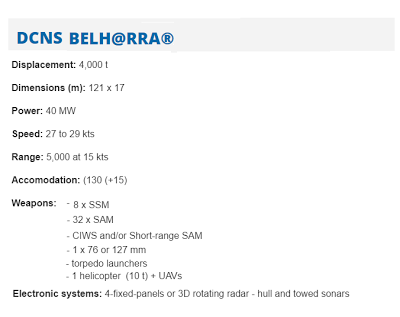
⚓️ The new heavily-armed frigate made for the international market  BELH@RRA® frigate
With the BELH@RRA® frigate, DCNS intends to continue the success enjoyed by La Fayette-class frigates, a reference on the naval defence market with over twenty units sold to four navies around the world.
DCNS completes its product line by positioning a latest-generation vessel between the 6,000-tonne FREMM multi-mission frigate segment and that of the 2,500- to 3,000-tonne GOWIND® corvettes.
With the BELH@RRA® frigate, DCNS responds to the expectations of navies looking for a compact frigate, capable of ensuring long-range missions, operating alone or embedded in a naval force, on the high seas or as part of coastal surveillance missions in a dense and hostile environment.
 The new BELH@RRA® frigate offers operational intelligence that is unequalled on the market, in addition to a modular design, robustness and simplified use, which are all the fruit of the technological evolutions of the last few years. Ten years after the first design studies for the FREMM multi-mission frigate, DCNS’s latest frigate also capitalises on the experience of the French Navy with this vessel across a large number of operational theatres.
Thanks to the architecture and versatility of DCNS’s SETIS® combat-management system, proven on the FREMM frigates and GOWIND® corvettes, the BELH@RRA ® frigate will respond to the specific needs of client navies in all areas of warfare, whilst at the same time offering significant platform modularity to increase vessel payload or autonomy. The new frigate will offer cutting-edge performance for submarine warfare, an unprecedented aircraft detection capability and strengthened air-surface warfare capacities; a multi-mission foundation to which capacities responding to new threats such as asymmetric warfare or cyber-defence will also be added.
The first frigate for “digital natives”
Resolutely oriented towards future operators in command of vessels beyond 2020, the BELH@RRA® frigate benefits from digital technologies. These endow it with greater performance for data processing and threat detection whilst at the same time allowing the crew to concentrate on tasks with the most added value.
 The development of digital technologies guarantees the upgradeability of the vessel throughout its life-cycle. For a period of almost forty years, the equipment and systems will be incrementally modernised to adapt to evolutions in the operational context, future threats and the arrival of new technologies.
The BELH@RRA® in its French-Navy version, a programme that is already under way
DCNS already offers a French-Navy version of the new BELH@RRA ® frigate in the frame of the FTI (intermediate-size frigate) programme conducted by the French Procurement Agency (DGA) on behalf of the French Navy. For the French-Navy version, the BELH@RRA ® frigate is designed to satisfy France’s needs as defined by the French Ministry of Defence: a front-line frigate for anti-submarine warfare of a displacement of 4,000 tonnes equipped with widened self-defence and commando-projection capacities. Last but not least, it integrates the Thales Sea Fire® four flat antenna radar and is equipped with ASTER® 30 missiles from MBDA.
* DCNS has named its new frigate BELH@RRA® in reference to Europe’s only giant wave: the Belharra. The first “a” transformed into an @ makes reference to the highly digital nature of the frigate proposed by DCNS
♞ After several days of investigation, the U.S. Navy believes an urgent warning about an incoming missile aboard a destroyer Saturday night may have been a false alarm, defense officials said Tuesday. The guided-missile destroyer Mason, underway in the Red Sea off the coast of Yemen, detected a “possible inbound missile,” prompting the ship’s commander to activate the missile defense system and launch interceptor missiles, defense officials said.
Navy Capt. Jeff Davis, a Pentagon spokesman, said the commander’s decision to fire the missile defense system was “appropriate,” but there has been no confirmation of an inbound missile posing a threat to the U.S. ship.
“We have not actually confirmed that that happened,” Davis said Tuesday.
“We are not ready to call it an 'attack',” he said. “We are going back and reviewing the information to see what happened.”
The incident underscores the heightened tension in the Red Sea after two confirmed missile attacks on U.S. ships last week came from territory in Yemen that is controlled by the Iran-backed Houthis rebels.
Military officials use an array of sensors to investigate possible missile attacks, including radar systems from other U.S. ships in the area, U.S. aircraft overhead and satellite imagery.
“We look at a lot of different points of information. It’s not just one single ship and one single radar system," Davis said.
The two confirmed attacks, on Oct. 9 and Oct. 12, were the first known instances of a U.S. Navy ship engaging its Standard Missile-2 air defense system outside of training situations. The SM-2 system uses interceptor missiles to destroy incoming missiles at long-range by either striking them or detonating nearby and knocking them off course. The SM-2 is used before last-resort self-defense systems, like the shorter-range Sea Sparrow missiles.
On Thursday, the destroyer Nitze fired Tomahawk missiles into southern Yemen, where the cruise missile attacks originated. The U.S. rockets destroyed three radar sites in the area controlled by Houthis rebels, who receive support from Iran. The coastal radar systems provided key targeting data to the cruise missiles fired from Houthis-controlled area.
The U.S. ships were in international waters at least 11 miles from the coast.
Cruise missiles can travel at about 600 miles per hour, giving U.S. ships between one and two minutes between detection and possible impact.
Many experts believe the cruise missiles may have come from Iran.
The recent attacks from the Red Sea will likely make thousands of sailors eligible for Combat Action Ribbons, a citation the Navy has not bestowed on the crew of a ship in international waters since the Gulf War in 1991.
 CN 235 MPA TNI AU produksi PT DI [Iben Saputra] ☆
 "Landasan pacu di daerah terpencil pendek dan permukaannya kasar atau berumput," katanya.


