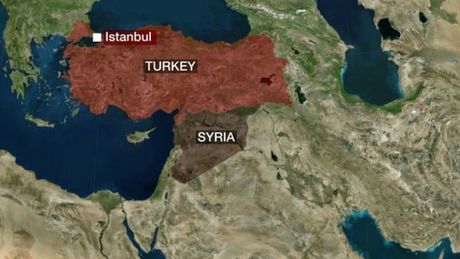
 Ilustrasi (BBC)
Turki menembak jatuh helikopter Suriah yang masuk ke wilayah Turki. Namun pihak Suriah menyatakan benda itu hanyalah drone, bukan pesawat berawak.
Sebagaimana dilansir AFP, Minggu (17/5/2015), helikopter Suriah itu ditembak jatuh di area perbatasan Cilvegozu, melintasi wilayah Hatay, Turki sebelah selatan yang berbatasan dengan Suriah, pada Sabtu (16/5) waktu setempat.
"Sebuah helikopter Suriah dijatuhkan di perbatasan dalam lima menit pada batas tujuh mil (11 kilometer)," kata Menteri Pertahanan Turki Ismet Yilmaz sebagaimana dikutip oleh agensi pemberitaan Dogan.
Insiden ini menandai ketegangan baru antara Turki dan rezim Presiden Bashar Al Assad dari Damaskus Suriah. Yilmaz mengucapkan selamat kepada angkatan bersenjatanya karena berhasil menembak jatuh helikopter Suriah.
"Mereka telah dengan benar menjalankan tugasnya, saya ucapkan selamat kepada angkatan besenjata dan mencium mata mereka," kata Yilmaz dengan ekspresi tradisional Turki.
Meski begitu pihak Turki tak menggambarkan detail lebih lanjut jatuhnya helikopter itu. Angkatan bersenjata Turki menyatakan dua pesawat jet F-16 telah bertarung dengan penyusup Suriah di udara.
"Helikopter itu akhirnya jatuh di teritori Suriah," kata angkatan bersenjata Turki.
Perdana Menteri Turki Ahmet Davutoglu mengkonfirmasi bahwa helikopter suriah itu telah ditembak jatuh. Dia mengucapkan selamat kepada pilot Turki atas kekuatan dan jasanya. Dia memperingatkan Turki tak akan ragu menindak pelanggar perbatasan.
"Tak peduli siapa Anda, siapapun yang melanggar perbatasan kami, akan kami hukum. Saya harap pesan ini diterima dan tak akan ada yang berani melanggar perbatasan kami lagi," kata Davutoglu dalam wawancara dengan stasiun televisi Star.
Sebuah sumber menyatakan kepada harian Hurriyet bahwa objek terbang tersebut hancur menjadi tiga bagian dan jatuh di perbatasan sisi Suriah. Namun Suriah sendiri membantah bahwa yang ditembak Turki itu adalah pesawat berawak manusia.
"Tidak benar bahwa pesawat tempur Turki menembak jatuh pesawat Suriah. Yang ditembak jatuh itu adalah sebuah drone kecil yang terbang di sekitar situ," kata siaran televisi Negara Suriah mengutip sumber militer.
Presiden Turki Recep Tayyip Erdogan telah muncul sebagai lawan dari Assad. Turki dituduh juga sebagai pihak yang mempersenjatai oposisi Islamis melawan Assad. Namun Ankara (Ibu Kota Turki) selalu membantah hal itu.
Sebelum kejadian penembakan jatuh pesawat Suriah, ada sejumlah kejadian serupa. Pada Maret 2014, Turki menembak jatuh pesawat tempur Suriah. Ada pula helikopter Suriah yang ditembak jatuh pada September 2013. Sebuah pesawat jet Turki juga ditembak jatuh oleh Suriah pada 2012. (dnu/bar)
 Desain LMV Singapura [Sing Mindef] ☆
Angkatan Laut Republik Singapura (RSN) mengumumkan nama-nama delapan Littoral Mission Vessels (LMVs). RSN pertama, RSS Independence akan diluncurkan pada tanggal 3 Juli 2015 dengan upacara peresmian oleh Menteri Pertahanan Dr Ng Eng Hen.
Nama-nama tujuh LMV lainnya adalah RSS Sovereignty, RSS Unity, RSS Justice, RSS Indomitable, RSS Fortitude, RSS Dauntless dan RSS Fearless.
LMVs akan menggantikan Kapal Patroli Fearless class yang telah melayani Angkatan Laut Singapura selama 20 tahun ini. LMVs akan meningkatkan kemampuan pertahanan dan menegakkan kedaulatan laut Singapura.  Desain LMV Singapura ☆
LMV memiliki bobot 1.200 ton, panjang 80 m dan lebar 12 m dibekali dua mesin diesel MTU 20V 4000 M93L berkapasitas 11.532 hp memberikan kecepatan maksimum 27 knot dengan daya jelajah 5.000 mil laut dengan kecepatan jelajah 15 knot.
Di tengah kapal terletak dek pendaratan heli yang dapat menampung helikopter Sikorsky S70B Seahawk. Sementara diburitan ditempatkan dua boat berkecepatan tinggi. Di bawah helipad terdapat ruang luas yang dapat mengakomodasi muatan modular sesuai misi tempurnya. LMV diawaki oleh 30 orang.
LMV dilengkapi persenjataan meriam otomatis 76mm Oto Melara super rapid, dua cannon RWS 25mm Rafael Typhoon dan dua senapan mesin RWS Oto Melara HITROLE 12.7mm. Kapal dilengkapi dengan radar deteksi baru Thales NS (Naval Smarter) 100 Afar yang beroperasi di S dan X band dan dilengkapi sistem pengendalian tembakan elektro optik produksi Sagem serta satellite communication system Airbus Defence and Space SCOTPatrol, semua sistem terpasang di satu tiang terpadu.
 Russian T-14 Armata main battle tanks take part in the 9 May 2015 Victory Day Parade in Moscow. [PA Photos]
Paraded uncovered for the first time on 9 May in Moscow, Russia's new range of armoured vehicles represent not only the biggest change in the country's armoured vehicle families since the 1970s but also a new design ethos.
While the vehicles' designs partly involve radical rather than revolutionary innovation, the scale and ambition of the change they embody is nothing short of a revolution. Together, the Armata, Kurganets, Boomerang, and Koalitsiya and other vehicles on show will replace nearly all Russia's existing vehicle families as, remarkably, Russia is attempting to replace all its main armoured fighting vehicle (AFV) families at the same time.
Additionally, the new vehicles display radical changes in design ethos and incorporate multiple previously unseen active protection systems (APSs). The reported weight and the apparent size of all the vehicles indicates a shift in armoured vehicle design philosophy away from the Soviet emphasis on manoeuvrability and low vehicle profile towards the Western focus on armour protection and crew survivability.
While many details of the vehicles had already been known, and were covered in depth by JDW in April, the full unveiling of the vehicles has revealed many fascinating new details and added greatly to our understanding of the vehicle family designs.T-14 Armata main battle tank (MBT) Russia's T-14 Armata MBT (IHS/Andrey Kryuchenko/Russian MoD)
The T-14 is Russia's first truly new tank design since the T-72, designed in the early 1970s. Based on the Armata Universal Tracked Platform, the T-14's most attention-grabbing feature is its unmanned turret, with all of the MBT's three crew (commander, driver, gunner) seated in a well-protected crew compartment at the front of the hull.
Seven T-14s took part in the parade and the type is slated to replace the Russian Ground Forces' T-72M3 and T-90 main battle tanks (MBTs) currently in service.
Notably, the unveiled turret dispels suggestions the MBT would be armed with a coaxial 30 mm cannon, in addition to its 2A82A 125 mm main gun. Indeed the pre-production vehicles paraded by Russia feature neither a 30 mm cannon nor a coaxial machine gun (MG) armament as expected, although the production vehicles might eventually feature the dual 30 mm cannon/7.62 mm MG.
Although the T-14's turret features a large bustle, it remains unclear whether this features the autoloader/weapon-handling system for the MBT's main gun or serves another purpose (meaning the T-14 would retain the vulnerable hull-mounted carousel system present in previous Russian MBTs). Some reports also indicate Russia has not entirely abandoned its ambitions to arm Armata with a 152 mm main gun. If this is the case, it could explain why the T-14's unmanned turret has an unusually high profile relative to the position of the 125 mm main gun, with the turret possibly designed to incorporate growth potential up to the 152 mm calibre.
T-14 is armed with a remote-controlled turret (RCT) armed with a 7.62 mm PKTM MG, with the unit also functioning as the commander's independent sight. The gunner's sight is mounted to the left side of the main gun and shielded by a two-piece armoured door to protect it from small arms fire. A barrel reference unit is mounted above the base of the 2A82A main gun, which notably lacks a fume bore extractor (which would be superfluous given the turret is unmanned). Metrological, satellite communications, GLONASS, datalink, and radio communications antennae are fitted on the roof of the turret.
The MBT's turret is literally covered in a variety of launcher and sensor systems understood to be linked to a new APS system, which some reports call 'Afghanit'. At the base of each side of the turret are five large and fixed horizontally arrayed launch tubes covering the 120° frontal arc of the turret. These bear a strong resemblance to the launchers for the earlier Drozd and Drozd-2 APS, which fired a hard-kill 107 mm unguided projectile armed with a high-explosive-(HE) fragment warhead to defeat incoming anti-tank guided weapons (ATGWs).
The T-14 is also fitted with four sets of smaller-calibre launchers, with each unit armed with 12 launch tubes. Two horizontally trainable launcher units are fitted on either side of the top of the turret, while two apparently fixed and vertically facing launcher units are recessed into the top of the tank's turret.
It is unclear whether this second system fires hard-kill (ie warheads) or soft-kill (ie anti-infrared/laser-obscuring smoke) munitions, or a combination of the two. It is also unclear if the vertically mounted units are fireable, or simply storage for reload units for the two trainable launchers. One limitation of the Drozd systems were that they provided no protection against threats emanating from above the tank, so mounting the fixed launchers vertically could be one way to provide protection against top-attack threats.
Providing warning and guidance for the APS system are two types of sensors mounted around the T-14's turret. Two large sensors, believed to be electro-optical/infrared (EO/IR)-based laser warning receivers, are angularly mounted on the front of the turret providing 180° coverage, while four smaller sensors (covered but believed to be radars) are mounted around the turret providing 360° coverage.
Armata features a notably different hull design to the T-72/90. One striking difference is the road wheels, which are of a different design to the T-72/90's, while the Armata features seven road wheels, to the six of the previous MBT designs, with the drive wheel at the rear. This is similar to the T-80 MBT family, which also has chassis with seven smaller road wheels.
It is not known whether Armata is equipped with a gas-turbine or a diesel engine, but the T-14's powerpack is mounted at the rear of the MBT, with two internal fuel tanks mounted on either side, and exhausts also mounted on either side. Day/night cameras are mounted around the T-14's turret to provide situational awareness, while a forward-looking EO/IR (FLIR) system is mounted on the front of the hull for the driver. The driver's hatch has no periscopes. When driving buttoned-down, the driver may be in a reclined position, using a set of periscopes mounted on a second hatch directly behind him.
NII Stali is understood to have designed a new form of steel armour for the Armata family. Speaking to TASS, a NII Stali representative said the "steel armour alloy, named 44S-sv-Sh [44S--], is approved by the Armata's developer. The alloy's operational testing has been started and it can be used in prospective vehicles' parts". The use of the 44S-sv-Sh steel in Armata is intended to provide protection at a similar level to STANAG 4569 (first edition) Level 5. The high level of 44S-sv-Sh's protection is ensured by the short-grained material structure, the optimised legation process and the special heat processing. The steel has also been designed to maintain its characteristics in very cold conditions.
The Armata design is also understood to utilise explosive reactive armour (ERA) within its base design (rather than the appliqué ERA tiles seen on previous Russian MBTs), with views from above the MBT showing a distinctive tiled pattern indicative of ERA on the top of the vehicle's chassis and turret. Although what appear to be ERA tiles are present on the turret roof, much of the sides of the turret appears to be just a thin cladding covering the various APS and sighting systems rather than armour. Appliqué armour (unclear if passive or ERA, or both) is fitted to the forward two thirds of the T-14's sides, while the rear third is protected by bar armour to provide clearance for the T-14's exhausts.T-15 Heavy Infantry Fighting Vehicle (IFV) T-15 Armata heavy infantry fighting vehicles (IFV) take part in the Victory Day Parade in Moscow. (PA Photos)
Also based on the Armata universal platform and fully unveiled during the 9 May parade is the T-15 Heavy IFV.
For the creation of the T-15 the Armata chassis has been reversed in its entirety to create a compartment to accommodate dismounts at the rear of the IFV. Accordingly, the T-15's powerpack is mounted at the front of the vehicle, with the drive wheel also at the front and the exhausts now on the forward sides of the vehicle.
This swap has necessitated relocating the vehicle's fuel tanks, while to protect the normally weaker armour of the rear of the Armata chassis a distinctive arrowhead-shaped armour package extends around the forward sides of the vehicle. To accommodate the vehicle's exhausts the side armour is overhanging rather than arrowhead. The overall effect of this is to give the vehicle an odd, bulbous appearance. The top of the vehicle's chassis appears to be protected by integrated ERA tiles. Russia's T-15 Armata Heavy IFV. (IHS/Andrey Kryuchenko/Russian MoD)
The T-15 is armed with a KBP Instrument Design Bureau Epoch Almaty-designed RCT at the rear of the vehicle equipped with a 30 mm 2A42 cannon, 7.62 mm coaxial MG, and a bank of two Kornet-M ATGWs on either side. The RCT features a gunner's sight to the right of the main gun and an independent commander's sight on the top of the turret on the left-hand side.
The heavy IFV is also fitted with an advanced armour package on the side of the vehicle. The T-15 appears to feature the same APS sensors and launchers as seen on the T-14, although mounted on the hull of the vehicle rather than its turret.
A three-man crew (commander, gunner, driver) are located in the centre of the vehicle, behind the engine, with the rear of the vehicle's hull raised to accommodate the troop compartment and turret. Egress from the crew compartment is made via a power-assisted door at the rear of the vehicle.
The front/underside of both the T-14 and T-15 is fitted with what appears to be a small entrenching/counter-mine system.IFV Kurganets-25 Russian Kurganets-25 IFVs take part in the 9 May 2015 Victory Day Parade in Moscow. (PA Photos)
The lighter, 25-tonne, Kurganets-25 was present in two variants at the 9 May parade: IFV and armoured personnel carrier (APC). The new vehicle family appears significantly wider and taller than BMP series of vehicles it is slated to replace.
The IFV variant is armed with the same 30 mm cannon/Kornet ATGW armed turret as the T-15. Uralvagonzavod has also created its AU-220M turret armed with a 57 mm cannon, which is understood to be in contention to be fitted to the IFV variant, although this was not fitted to the Kurganets-25 IFVs taking part in the parade.
Much like the Armata vehicles, the Kurganets-25 IFV appears to feature two types of APS sensor and effector, although these appear subtly different to those on the Armata vehicles. Fixed launchers are placed all around the vehicle hull, providing 360° coverage. While these resemble the launches on the Armata vehicles, they appear to be of a much smaller calibre. A two-part sensor system, similar to the laser-warning receivers on the Armata vehicles, is also located around the hull. Oddly, three sensors are located on the left-side of the vehicle, but only two on the right-side. Given both sets of sensors and effectors are located on the hull, it would appear the two systems are linked. Kurganets-25 IFV. (IHS/Andrey Kryuchenko)Kurganets-25 IFV. (IHS/Andrey Kryuchenko)
Three two-part sensors (covered during the parade) are also mounted around the turret, along with four sets of effectors on the front of the turret and two mounted sidewise on the rear of the turret. It is unclear what these effectors are, but they appear similar to an unknown system seen mounted on the turret of the earlier T-95 (Object 195) prototype MBT. On the IFV, each set has a pair of what are either round windows or frangible covers. If they are windows, this system could be a new APS interference emitter similar to a greatly slimmed-down version of the soft-kill Shtora system present on the T-90. Alternatively, each set could contain two of the effectors from the smaller-calibre launchers on the Armata vehicles. Given that the coverage provided by the location of the effectors appears to intermesh, the latter option seems more likely.
The APC version, meanwhile, is fitted with a much smaller RCT armed with 12.7 mm MG. The APC lacks the hull-mounted sensors or effectors seen on the IFV variant, and instead features solely the second APS type present on the Kurganets-25 IFV. While the sensor configuration is the same for this APS on both the APC and IFV variants, the configuration of the effectors differs. On the APC vehicle, the effectors are located only on the front of the turret and instead of six sets of paired effectors, there are four sets of paired effectors, and four sets of single effectors.
Both the APC and IFV variants are otherwise identical, with a forward-mounted powerpack and seven road wheels. Commander and driver's hatches are present in front of the turret, with access to the troop compartment via a rear door. Unlike in previous Russian IFV designs, there are no other hatches for troops carried inside, apart from the rear door. Neither variants feature any obvious ERA, although ERA has not typically been fitted to Russian IFVs.
Both feature a large appliqué kit to the sides of the vehicle, although whether this is principally for armour or flotation purposes is unclear. Amphibious capability has been designed into the Kurganets family, with both featuring a bow plane and waterjets installed within the rear of the hull.Boomerang Russian Ground Forces Bumerang (Boomerang) 8 x 8 infantry fighting vehicle (IFV). (Nikolai Novichkov)
The Boomerang 8x8 vehicle also made its full debut at the 9 May parade, and is intended to replace the BTR-family of vehicles, the most recent variant in Russian service being the BTR-82A.
The 8x8 is armed with the same turret as both the T-15 and the Kurganets-25 IFV, although the examples taking part in the parade were fitted with no APS systems. An APC variant fitted with an RCT with a 12.7 mm MG is also understood to be planned. Boomerang 8x8 IFV. (IHS/Andrey Kryuchenko)
Boomerang's powerpack is located in the front right-hand side of the vehicle, with the driver at the front-left side of the vehicle. Neither the vehicle's commander nor gunner have their own hatch, although unlike the Kurganets vehicles there are two roof-hatches for the troop compartment.
With the engine located in the front of the vehicle, troops can egress via a door at the rear of the vehicle, unlike the awkward side doors of the BTR series (which had their engine at the rear).
Also designed to be amphibious, Boomerang is equipped with a bow plane at the front of the hull and shrouded propellers at the rear of the 8x8.Koalitsiya-SV Russia's Koalitsia-SV (Coalition-SV) self propelled artillery system (SPA) takes part in the Victory Day Parade in Moscow. (PA Photos)
Also shown off on the 9 May parade was the 2S35 Koalitsiya-SV (Coalition-SV) self-propelled artillery (SPA) system, which will replace the 2S19 MSTA-S SPA in Russian Ground Forces service.
This is understood to feature a new 152 mm ordnance utilising a modular charge system. This main gun features notably different muzzle brake and recoil dampeners to the earlier SPA. An RCT armed with a 12.7 mm MG is mounted on the roof of the turret. There are two bundles of 902B Tucha smoke grenade launchers mounted on either side of the cabin and no other APS effectors, although four warning receivers are located on the SPA's turret. The main turret, understood to be unmanned akin to the T-14's turret, is significantly longer than the 2S19's. Koalitsiya 152 mm SPA. (IHS/Andrey Kryuchenko)
Although Koalitsiya-SV was slated to be based on the Armata universal chassis, the pre-production vehicles appear based on a modified T-72/90 chassis. The general layout and roadwheels appears to be identical to those on the T-72/90 chassis, although the front of the chassis has been heavily modified to create positions for the commander and gunner on either side of the driver. Unlike on Armata, where the driver is located on the right side of the vehicle, the driver on Koalitsiya is located in the centre of the vehicle (as seen in the T-72/90 and 2S19).
According to Georgy Zakamennih, chief director of TsNII Burevestnik, the developer of the 2S35, Coalition-SV has a maximum range of 70 km when firing advanced shells. He added that its ammunition load is larger than Western analogues. There is a unified command-and-control panel on which all the actions are displayed. The system's pneumatic loader is billed as increasing Coalition-SV's rate of fire. 2S35 can automatically choose the appropriate type of shell and fire it. Coalition-SV is therefore not a classic self-propelled gun but an innovative robotised complex, autonomous to a high extent, he said.
♘ IHS Janes
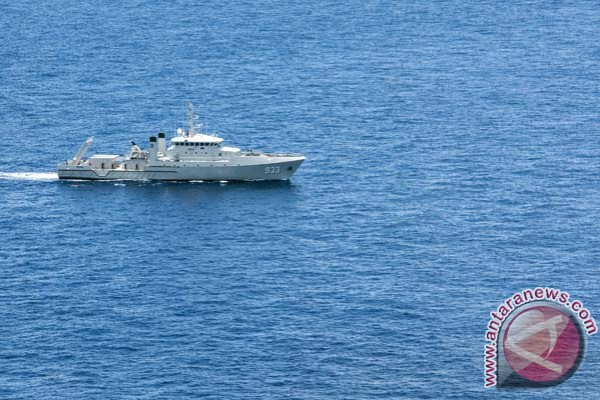 KRI Rigal Masuk Tanah Air KRI Rigel-933 TNI AL buatan Prancis memasuki perairan Indonesia dari pulau terluar wilayah barat, Sabang, Aceh, Rabu (6/5/15). (ANTARA FOTO/ M Agung Rajasa)
Tanpa memerlukan kapal tunda, KRI Rigel-933, kapal survei hidrografi canggih TNI AL terbaru, bisa menambatkan diri di dermaga Terminal Peti Kemas Pelabuhan Tanjung Priok, Jakarta, Jumat.
Kapal militer berkelir abu-abu laut itu tiba setelah 50 hari lalu berlayar dari galangan kapalnya, OCEA Dossier, di Les Sables-d’Olonne, Prancis, menuju Tanjung Priok.
Kepala Staf TNI AL, Laksamana TNI Ade Supandi, memimpin upacara militer penyambutan kapal perang terbaru TNI AL, di dermaga itu, Jumat.
“Indonesia memesan dua kapal survei di kelas ini kepada galangan kapal itu. Semuanya tepat waktu, baik pembuatan, pengujian, dan pengiriman,” kata Supandi, tentang kapal yang dikategorikan sebagai Multi Purpose Research Vehicle itu.
Setelah upacara penerimaan ini, KRI Rigel-933 akan ditempatkan di Dinas Hidrografi-Oseanografi TNI AL, dengan nomenklatur penomoran 9xx yang menandakan dia dikategorikan secara aset ke dalam jajaran kapal bantu.
KRI Spica-934  Ruang pemrosesan data (Sea and Marine)
Kapal kedua yang dipesan dari galangan kapal OCEA Dossier, di Les Sables-d’Olonne, Prancis, itu akan tiba pada September nanti.
Dia akan diberi nama KRI Spica-934, yang juga memakai nama rasi bintang, sebagaimana halnya dengan Rigel alias rasi Lintang Waluku (Jawa) atau Orion (Inggris/Barat).
Laiknya kapal survei hidrologi, KRI Rigel-933 seukuran panjang 60 meter dan bobot kosong 500 ton itu tidak dilengkapi senjata mematikan, hanya dua senapan mesin 12,7 milimeter yang ditancap di geladak samping kanan dan kirinya, plus senapan mesin 20 milimeter di bawah anjungan.
Yang menjadi keistimewaan kapal seharga 93,848 juta dolar Amerika Serikat ini adalah deretan instrumen khusus penera hidrologis dan oseanografis. Remotely Operated Vehicle (ROV), robot bawah air berfungsi sebagai survei geofisika, bisa menyelam hingga 1.000 meter, punya lengan dengan lima fungsi gerakan untuk ambil obyek di dasar laut. (Viva)
Di antara banyak keistimewaan dan kecanggihan instrumennya, yang paling menyolok mata adalah kehadiran Autonomous Underwater Vehicle mirip torpedo gemuk berwarna oranye terang, di dalam kontainer khusus di geladak luar buritan kapal.
Dialah yang menjadi andalan dalam memindai bentang alam laut mengandalkan sonar sisinya. Instrumen ini buatan Kongsberg, Norwegia.
Dia bisa beroperasi secara mandiri (otonom) berbasis data komputer yang telah diinput dan data keluaran hasil kerjanya bisa dipancarkan seketika waktu.
Masih didukung robot bawah laut buatan ECA Robotics, Prancis, yang awam biasa menamakan ini sebagai Remoted Operated Vehicle, dengan kamera tiga dimensinya. Olahan datanya bisa dilihat seketika di layar monitor dalam tampilan tiga dimensi.
“Dia bisa membedakan lapisan demi lapisan air laut di kedalaman, hingga mengenali perbedaan salinitas dan pergerakan arus air. Juga bisa membedakan apakah obyek yang dijumpai itu metal, bahan organik, dan sebagainya,” kata Kepala Subdinas Penerangan Umum Dinas Penerangan TNI AL, Kolonel Pelaut Suradi, secara terpisah.
Beberapa hadirin berkata, jika KRI Rigel-933 sudah tiba saat musibah AirAsia Qz8510 terjadi maka proses SAR korban dan evakuasi reruntuhan pesawat terbang itu bisa lebih cepat dan efisien.
KRI Rigel-933 yang baru tiba ini masih dalam pendampingan pembuatnya, galangan kapal OCEA Dossier.
“Kapal kami ini sangat istimewa, beberapa negara telah memesan. Bisa untuk kepentingan militer ataupun sipil sepenuhnya, tergantung keperluan," katanya.
"Yang penting juga, Angkatan Laut Prancis juga memakai kapal sama dengan yang dipesan Indonesia ini,” kata Manajer Proyek OCEA Dossier, Luc Boulestreau.
Dia turut menyaksikan detik-detik kehadiran KRI Rigel-933 di Tanjungpriok itu. Senyumnya mengembang saat kapal berbodi alumunium itu bisa bermanuver baik dan ditambat.
“Masih banyak sekali keandalan kapal ini yang harus dikuasai sepenuhnya dan kami siap mendukung sepenuh hati,” kata Boulestreau.
♘ antara
 Helikopter Chinook [Wikimedia]
Indonesia berkeinginan untuk membeli empat buah helikopter tempur Chinook dari Amerika Serikat.
Hal itu disampaikan oleh Menteri Pertahanan RI Jenderal TNI (Purn) Ryamizard Riyacudu dalam rangkaian kunjungan kerja ke Pabrik Boeing di Philadelphia. Di pabrik tersebut diproduksi berbagai jenis helikopter tempur termasuk Apache dan Chinook.
Disebutkan dalam siaran pers Pusat Komunikasi Publik Kementerian Pertahanan yang diterima redaksi (Minggu, 17/5) disebutkan bahwa sebelum melakukan kunjungan kerja ke Washington DC, rangkaian kunjungan kerja Menhan RI diawali pertemuan dengan United States Pacific Command (US PACOM) Commander Admiral Samuel J. Locklear dan United States Army Pacific (US ARPAC) Commander, General Vincent K. Brooks, di Hawaii.
Dalam pertemuan tersebut, kedua belah pihak sepakat dilakukannya peningkatan kerja sama pertahanan dan militer, meliputi pelatihan maupun latihan bersama, pertukaran instruktur dan latihan untuk Kopassus serta Marinir.
Hal lainnya yang menjadi topik pembicaraan antara lain, pertukaran pandangan tentang perkembangan situasi keamanan di Laut China Selatan yang berisi ajakan kepada semua pihak untuk menjaga stabilitas dan keamanan kawasan itu dengan menghormati code of conduct di Laut China Selatan.
Selama di Hawaii, Menhan RI juga berkesempatan mengunjungi Squadron US Navy P-3C Orion sebagai satuan penerbang pengintai Keamanan Maritim Angkatan Laut AS. [mel]
♘ rmol
 Ilustrasi (BBC)


